

PSA 10 Gem Mint and Corners: A Deep Dive
We all know that cards are graded via four main areas: corners, centering, edges, and surface. While eye appeal plays a role, aspects like corner damage and centering are somewhat objective and quantifiable. Let’s take a look at a PSA 10 and assess corners, specifically.
I realize most people aren’t used to this type of analysis, but you have to start somewhere—so let’s jump in.
Quantifying Corners
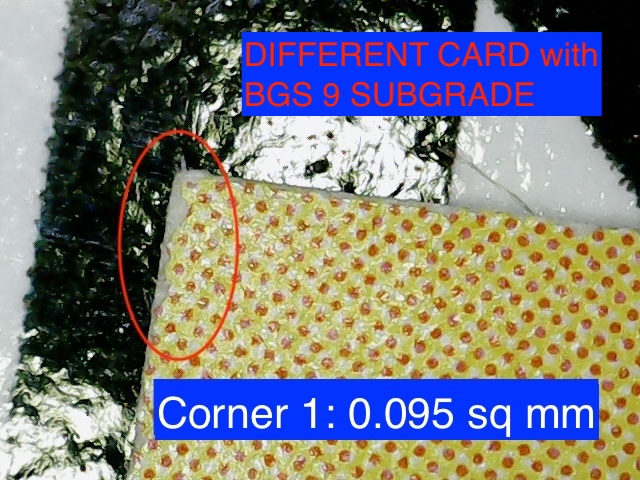
When I’m grading and screening cards, I generally look for the corner’s maximum defect sizes to be under 0.05 sq mm for a 10, under 0.10 sq mm for a 9, and under 0.20 sq mm for an 8.
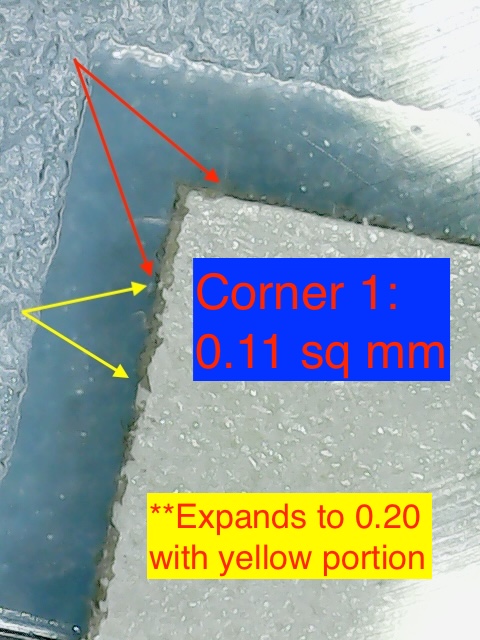
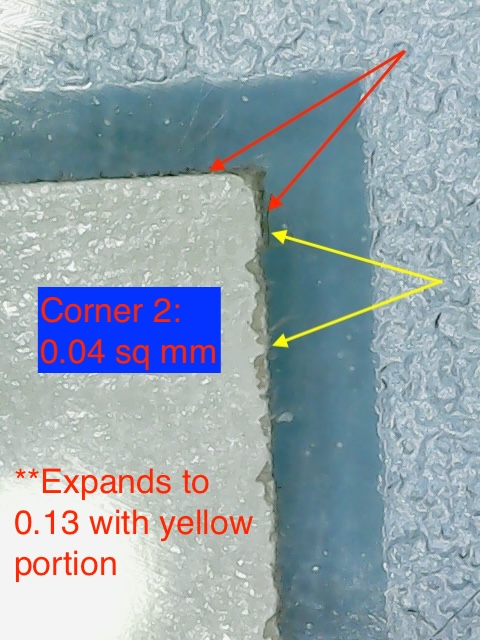
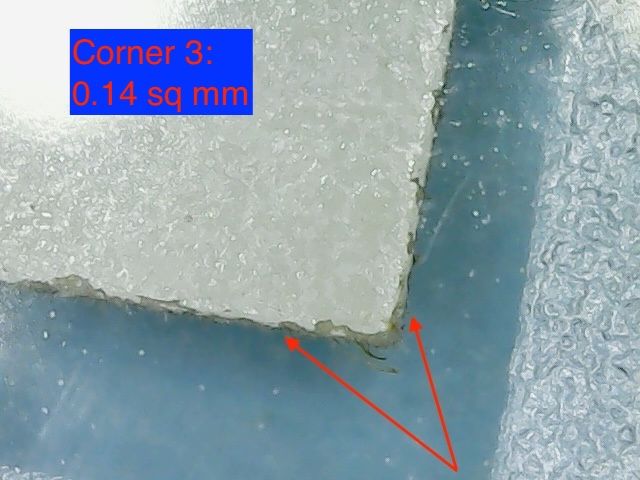
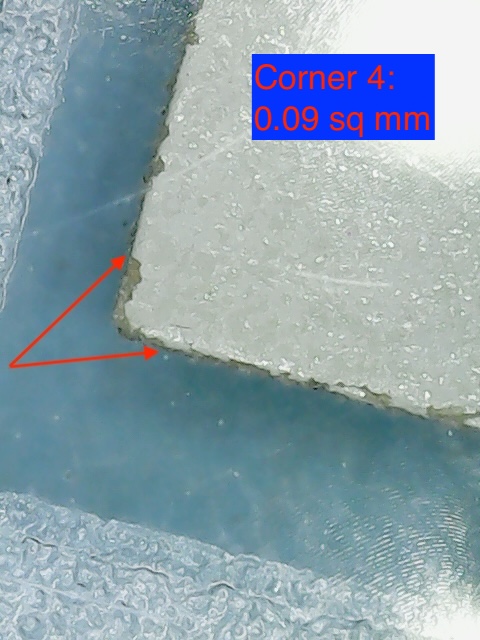
Yes, we’re talking about defects less than one-tenth of a square millimeter in size. Here are some examples from the PSA 10 Perez in question:
CORNER DEFECT SIZE — SURFACE AREA:
Corner 1 (top left corner): 0.11 sq mm
Corner 2 (top right): 0.04 sq mm
Corner 3 (bottom right): 0.14 sq mm
Corner 4 (bottom left): 0.09 sq mm
–defects are SURFACE AREA, not length
For those wondering, this was developed from a mix of empirical analysis (i.e. studying BGS subgrades) and experience with grading — as well as a desire to make the Corner subgrade quantifiable.
Corners occupy a very interesting place in the grading realm. After centering, corners are arguably the most objective and quantifiable of the four subgrades — and especially at the high end, corners can be described pretty completely by measuring the size of ink and paper loss, with relatively few other variables.
Corners vs. Surface
Compare that to something like surface, which would need to account for size, length, location, depth, concentration, etc …for all the things that can go wrong on the surface — wrinkles, creases, dimples, scratches, print dots, imprints, and so on.
With so much complexity, surface is highly subjective and unique to every card — each card is basically an edge case. Contrast that to the other end of the spectrum: Centering is measurable, quantifiable and almost completely objective.
From those extremes, corners fall much closer to centering on the objective-subjective scale, and is very conducive to quantification. Most high-grade corner issues fall within a narrow band of defects involving ink loss and small amounts of paper loss. At the NM and NM-MT levels, you can see tiny creases or bends, as well as deeper color breaks, but the majority of defects still come down to measurable ink and paper loss and are thus very conducive to quantification.
Measurement is therefore a great tool for analyzing corners, especially on the higher end.
No doubt, the key variable here when analyzing is size—the smaller the defect, the higher the grade. Pretty straightforward.
If we dig a little deeper, I’d argue defect shape matters too. Longer, thinner defects — like the ones on Corner 1 — tend to be harder to see with the naked eye because they’re more spread out and don’t draw the eye’s attention. This matters quite a bit when eye appeal is concerned.
By contrast, Corners 3 and 4 have damage that’s thicker and more concentrated, making them a bit more noticeable to the naked eye.
This becomes very apparent when distinguishing long, thin NM defects from NM-MT and MINT defects — something I learned the hard way numerous times early on. If you look at the pictures though, you’ll notice that, even here, there are some confounding variables.
Corners vs. Edges
One question I keep coming back to is, How do we define the boundary between a corner and an edge? You can see this clearly with Corners 1 and 2. I typically define corner damage as being the continuous area of damage extending from the tip of the corner to the end of the defect. For example, Corners 1 and 2 have two separate defective regions.
I have tended to classify the area within the red arrows as corner damage, and the yellow-highlighted areas as edge damage since the two aren’t connected. Corner 1 is arguably one contiguous area of damage, but I tried to give the grader a little leeway here from their final grade.
I think this is a particularly important question we need to answer — where does the corner “end” and the edge “begin”? Should corner damage only include continuous regions? Should it extend a fixed distance from the corner (i.e. 2 mm)? Or is there a better framework? I’m interested to hear how others think it should be defined. There’s more than one way to approach this.
PSA and BGS Guidance
Getting back to this particular example though, I personally don’t agree with the final grade, as I find these defects to be fairly significant for a Gem Mint 10. Based on the size of the corners defects, I had assigned a subgrade of 8 or 9 — NM-MT based on the measurement standards, but MINT to the naked eye.
From there, I could’ve accepted 8 or 9 as the overall grade, leaning closer to Mint from eye appeal. A 10 would be defensible as a sort of Min-Gem, but with the corners as they were, I consider this one an overgrade.
As for the publicly available, largely vague standards of the major grading companies, we have this guidance…
From PSA: “Attributes [of a PSA 10] include four perfectly sharp corners”
No doubt, these corners fail that written standard, whether or not a loupe is being used.
That said, I can assure you there is no such thing as a flawless card. Nearly every card exhibits damage under magnification… yes, even 10s — though there is the rare card that actually does exhibit a perfect razor sharp, 90-degree corner. They’re quite striking when you find them — I’ll show you one sometime — though they are exceptionally rare and clearly are not the standard needed to hit a Gem Mint grade.
Beckett’s description seems to be the most in-line with how these play out in practice:
Gem Mint 9.5: “Corners: Mint to the naked eye, but slight imperfections allowed under magnification.”
That standard falls much closer to what I’ve seen in practice — even if it is open to interpretation — and would create a defensible place to call this particular card Gem Mint, though I still think it falls short, especially compared to the multitude of Mint subgrade cards with dramatically less damage. For comparison, I left pictures from a different card with a BGS 9 corner subgrade to illustrate that point.
Final Analysis
From this result — a PSA 10 graded in 2026 — what really stuck out to me was the combination of exceptional eye appeal and the need for clearer, more consistent standards—especially when we’re dealing with defects that are measurable.
If corners can be quantified this precisely, then the gap between an 8, 9, and 10 shouldn’t feel this wide. Whether you agree with my thresholds or not, I think the bigger takeaway is this: the more we can define and measure, the less we’re left guessing.
Because at the end of the day, a “10” should mean something consistent—not just something that looks good at a glance or left to a whim.
-Mike at www.bostoncardexchange.com
WE BUY HIGH END VINTAGE SPORTS CARDS. IF YOU’D LIKE TO SELL OR HAVE US REPRESENT YOU, CALL/TEXT AT 617-518-0546 OR EMAIL AT INFO@BOSTONCARDEXCHANGE.COM
